Frameless Glass Shower Door Price
Planning a bathroom upgrade? In Metro Vancouver, custom frameless glass shower doors typically range from $700 to $2900 installed, varying by layout, hardware, and glass thickness. Discover what drives these costs—from simple fixed panels to complex enclosures—and learn why choosing the right glass thickness matters.
In Metro Vancouver, a custom frameless glass shower door typically costs between $700 and $2900 installed, depending on the shower layout, hardware color, glass types. A fixed panel sits at the low end, and a single hinged door costs a little more. A corner enclosure or a large sliding system sits at the high end.
That range is wide because “frameless shower door” describes very different products. A boxed kit from a big-box store and a custom door measured to your tile are both called frameless. They differ in glass thickness, hardware and fit.
This guide breaks down what each option really costs and what drives the price. It also explains why glass thickness, 8mm versus 10mm, deserves more attention than it usually gets.
At GlassEdge, we sell & install great glass shower doors, office walls, safety glass railings, and mirrors. Every glass shower door comes with a safe 15-month warranty to give you peace of mind.

custom frameless shower doors featuring 10mm clear tempered glass

combine modern design, functionality & durability

crafted from durable 12mm tempered safety glass to enhance both safety and style
professionally measured and custom fabricated to fit your space perfectly
With over 10 years of glass industry experience serving Metro Vancouver, GlassEdge delivers expert craftsmanship and personalized shower solutions—call us, email us, or submit our online form today for your free, no-obligation quote!
The layout of your shower sets the price more than any other factor. These are typical installed ranges for custom 10mm clear tempered glass with standard hardware.
Each added panel or cornet raises the price
Plan view from above: tiled walls, glass in color, dashed arc=door swing
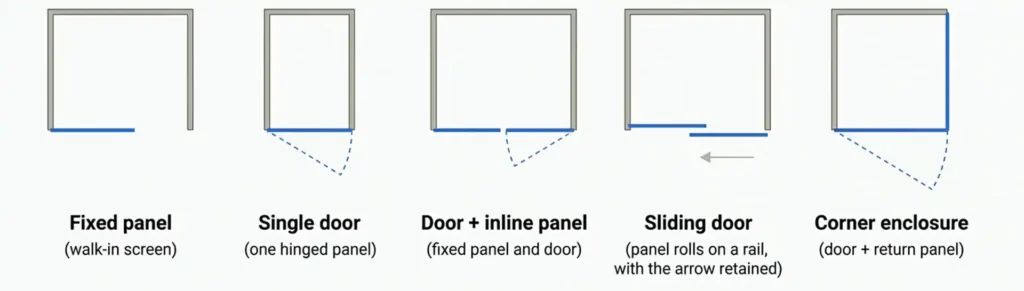
| Configuration | Typical opening | Installed price (CAD) |
| Fixed panel (walk-in screen) | 30 to 36 in. | $700 to $1,300 |
| Single hinged door | 24 to 30 in. | $800 to $1,200 |
| Door with inline panel | 48 to 60 in. | $1,200 to $1,800 |
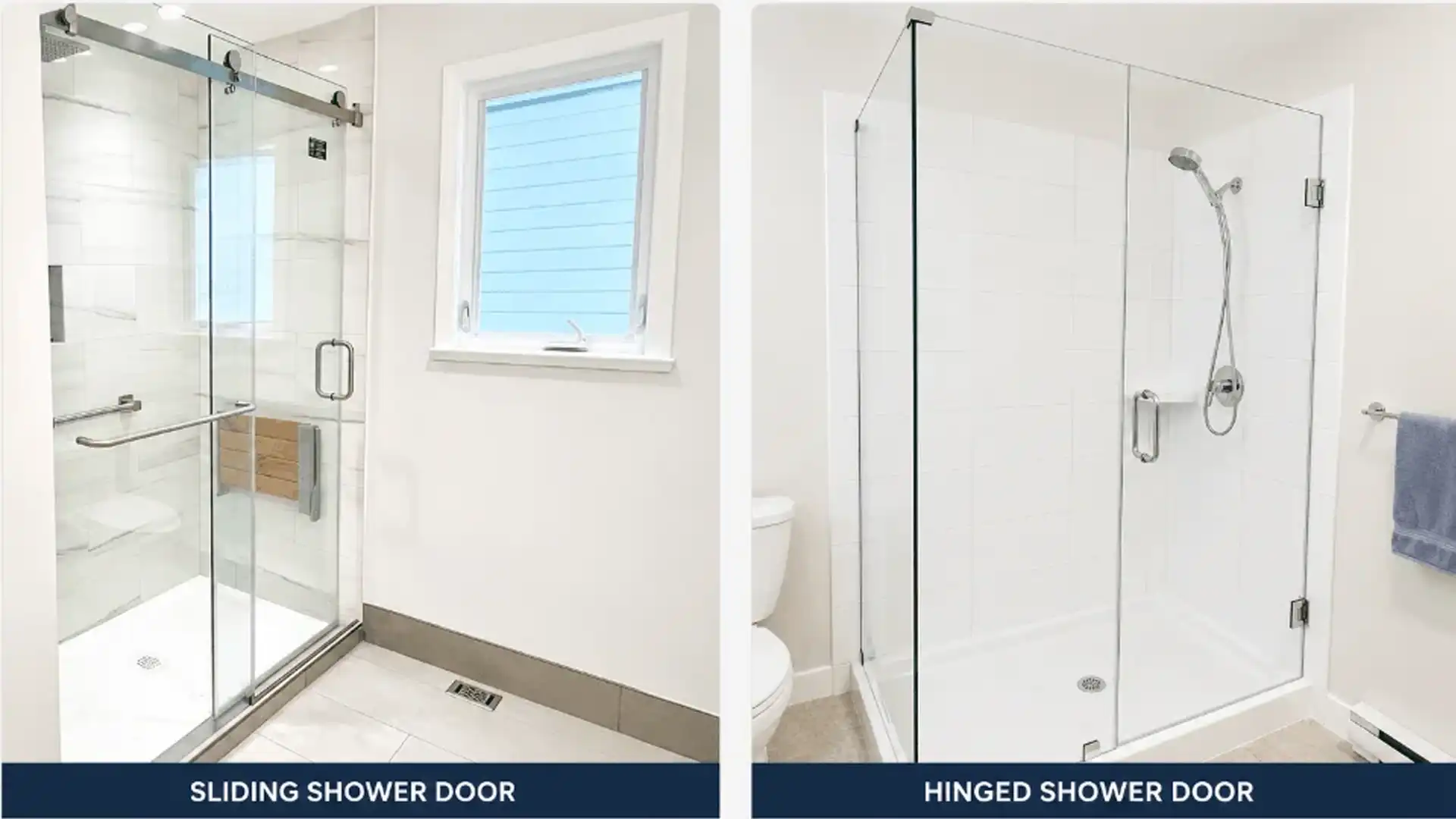
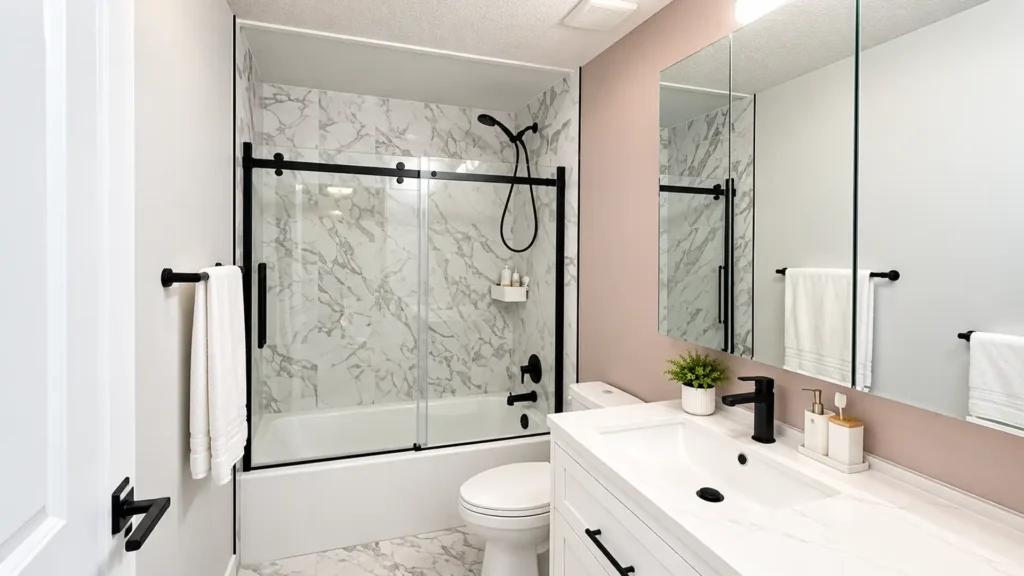
| Frameless sliding door | 48 to 60 in. | $1,300 to $1700 |
| Corner enclosure (door and return panel) | 36 x 36 in. to 60 x 36 in. | $1,600 to $2,300 |
Four things decide where your project lands in those ranges: the glass, the hardware, the layout, and the installation.
Glass is the largest part of the bill. Its cost depends on three choices.
A frameless door has no metal frame to carry it, so the hinges, clamps and handle do all the work. Finish matters too. Polished chrome, Matte black, and brushed nickel are almost same price but brushed gold, rubbed oiled bronze, brush bronze or any other customized color cost more for the same parts.
Every extra panel adds glass, hardware and labour. A single door in a tiled alcove is the simplest job. A corner enclosure needs a return panel and a glass-to-glass connection. A steam shower adds a transom and full seals.
Cut-outs add cost as well. A panel that sits on a bench or steps over a pony wall has to be notched to the exact shape before it is tempered. After tempering, glass cannot be cut again, so every measurement has to be right the first time.
No tiled wall is perfectly straight. A custom installer measures the finished opening, records how far each wall leans, and orders glass cut to match. That is why custom frameless glass sits tight to the tile without wide gaps or filler strips.
Installation covers drilling through tile, setting the panels, hanging and aligning the door, and sealing. It is skilled, two-person work, and it is included in the installed prices above.
The most popular frameless kits at big-box stores like Home depot or Costco use 8mm glass. At GlassEdge we build with 10mm glass as standard.
You can confirm this on the spec sheets. The MAAX Halo sliding door and the MAAX Reveal pivot door, both sold at Home Depot, list 8mm panels. So do the OVE Decors Kelsey and Renfrew sliding doors sold through Costco. Some budget models go thinner still, at 6mm.
A few retail kits do come in 10mm, such as a Hydro Vision sliding kit on Costco. The lesson is to read the glass thickness on the spec sheet, not the word “frameless” on the box.
There are good reasons kits use 8mm glass. They ship in a box, travel home in a pickup, and are designed for a homeowner to lift into place. They are also built in fixed sizes with a few inches of adjustment, so one model can fit many bathrooms. The Halo, for example, adjusts from 56.5 to 59 inches wide.

| Retail kit | Custom frameless | |
| Glass thickness | Usually 8mm, sometimes 6mm | 10mm standard, 12mm optional |
| Sizing | Fixed sizes with a few inches of adjustment | Cut to your finished opening |
| Out-of-plumb walls | Hidden by adjustable wall jambs or channels | Glass cut to follow the wall |
| Metal on the wall | Jambs, tracks or a header bar | Hinges and small clamps only |
| Installation | DIY or hired separately | Measured and installed by one company |
Custom 10mm glass needs far less metal than a retail kit

How a retail kit and a custom frameless door attach to the wall, front view
A shower package from Costco or Home Depot is a mass-produced product. It was not designed around your tile, so it cannot account for walls that are out of plumb. To solve that, these kits run metal channels around the edges of the glass to hide the gap.
It is a clever solution, but keep in mind what it means later. Soap scum and hard water collect inside those channels, and over time cleaning them becomes a nightmare. Anything extra around the glass, such as a channel, makes the shower much harder and more frustrating to keep clean.
In other words, you pay a lower price on the day you buy the kit, and you pay the rest over the long term in cleaning. Custom glass is cut to follow your walls, so there is no channel to clean.
Going from 8mm to 10mm sounds small, but it means 25 percent more glass in every panel and a door that is roughly twice as stiff.
10mm glass is 25% thicker and about twice stiff as 8mm
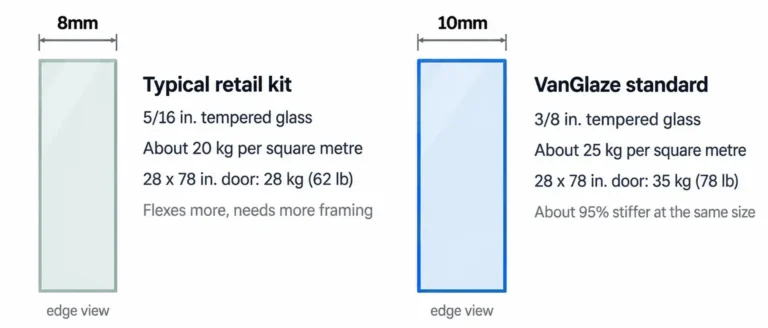
8mm vs 10mm tempered glass, edge view to scale
Glass weighs about 2.5 kg per square metre for every millimetre of thickness. A 28 x 78 inch door weighs about 28 kg (62 lb) in 8mm glass and about 35 kg (78 lb) in 10mm. You feel that weight every time the door closes. It is the difference between a hollow-core door and a solid one.
A panel's resistance to bending rises with the cube of its thickness. At the same size, a 10mm panel is about 95 percent stiffer than an 8mm one. This matters most for tall doors and for fixed panels held only at the wall and floor, where thin glass can visibly flex or wobble.
Because 10mm glass is rigid enough to stand on its own, it can be held by hinges and small clamps. Thinner glass often needs a header bar, a track or full-height wall jambs for support. The cleaner look people want from a frameless shower depends on the glass being thick enough to carry itself.
Hinges and seals last longer on a panel that does not flex. A door that stays rigid keeps its alignment, so it keeps closing on its seal instead of drifting over the years.
To be fair to 8mm glass, both thicknesses are tempered safety glass and both meet the same safety standard. An 8mm door is not unsafe. It is lighter, more flexible and more dependent on metal framing, and that is what you are comparing when you compare prices.
A kit’s shelf price is not its installed price, so the real gap between a kit and custom glass is smaller than it first appears.
Frameless kits generally sell for about $300 to $1200, depending on brand, size and finish. On top of that, plan for:
A custom quote covers the site measure, 10mm glass cut to your opening, the hardware, the installation and one company to call afterward.
For a standard 60-inch acrylic base, a kit is often the lower-cost route. For a tiled shower, the opening is rarely a kit size. Once installation is added, custom 10mm glass usually costs a few hundred dollars more for a door that fits the tile exactly.
You can lower the price of a custom frameless shower without giving up glass thickness.
Yes. The added stiffness and weight are what make a frameless shower feel solid, and the glass is the one part you cannot upgrade later.